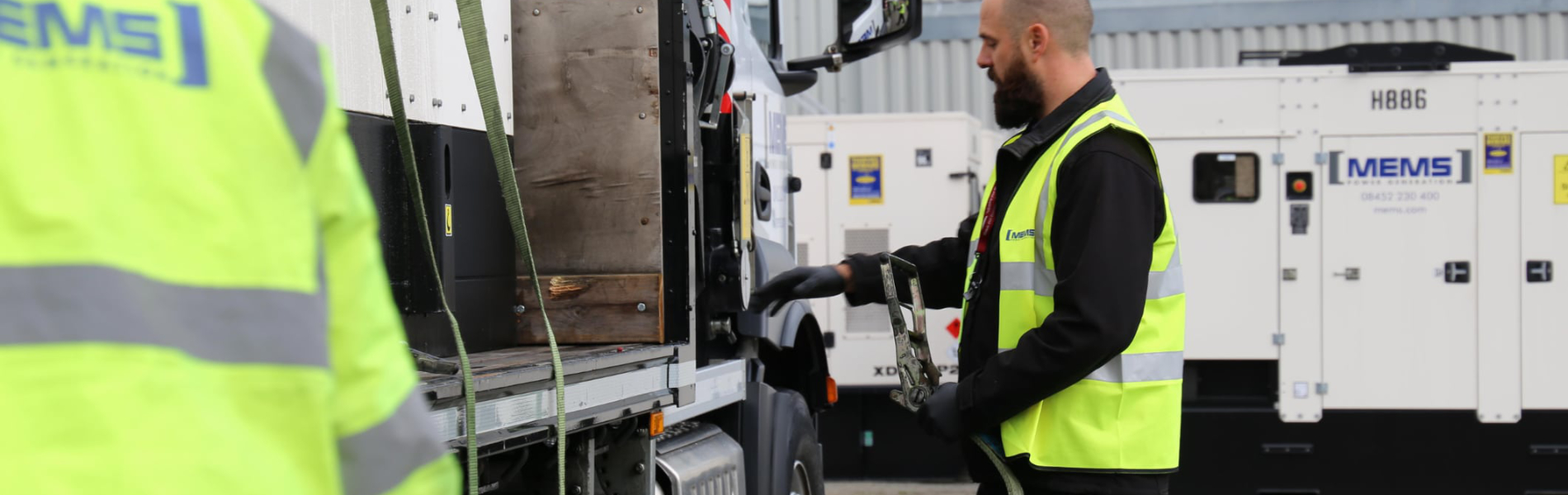



MEMS has completed a controlled drone generator delivery trial designed to explore faster temporary power deployment in access-restricted environments.
MEMS LAUNCHES RAPID REACH AERIAL GENERATOR DELIVERY TRIAL – April Fools Day!
MEMS Power Generation has announced the successful testing of MEMS Rapid Reach, a new aerial delivery concept designed to deploy generators to locations inaccessible to traditional vehicles.
The controlled trial involved the drone-assisted delivery of a 300 kVA Stage V generator to the MEMS Derbyshire depot. Developed in-house by the MEMS engineering team, Rapid Reach is intended for environments where road access creates delays, including dense urban centres, remote rural sites, rooftop installations, restricted site entrances, and time-critical emergency projects.

Maintaining Response Speed
When Access Is Restricted
Power demand does not pause for traffic delays or access constraints. Rapid Reach is evaluating whether aerial deployment can maintain response speed when ground transport is slowed.
“This trial marks an important step in exploring how we respond to access-restricted environments,”
said Mark Diffey, Director at MEMS. 1st April 2026
“Power demand does not always wait for ideal site conditions. Rapid Reach is about evaluating how technology might help us deliver equipment safely where a vehicle simply cannot go.”

Rapid Reach Aerial Generator Delivery Trial
The delivery was completed without reliance on road access, demonstrating the potential to bypass congestion-related delays and complex rerouting in time-critical situations. A passer-by at the Derbyshire depot was overheard saying, “Is it a bird? Is it a plane? No, it’s a MEMS generator!”
During the test, the generator was lifted, stabilised, and transported under controlled flight conditions before being positioned within a designated landing zone. The operation included pre-flight load simulations, real-time wind monitoring, calibrated stabilisation controls, and full ground-team supervision.
Engineering Evaluation and Next Steps
Further controlled trials are scheduled as MEMS continues to assess scalability, weather resilience, and regulatory considerations. Rapid Reach remains in the evaluation phase pending continued performance review.
“At this stage, we are focusing on equipment deployment only,” Mark added. “Although early internal discussions have touched on the mobilisation of aerial engineers for urgent callouts. Feedback suggests participation may depend heavily on wind speed.”
“Our engineering team enjoys a challenge,” he added. “When the idea was first raised, there were a few raised eyebrows, mostly from the team standing underneath the generator.”
Additional updates will follow as the programme develops.